 Guatemala
  México
  Perú
Perú  Costa Rica
  USA
USA Drip Tape vs. Drip Line: Which Is Right for Your Vegetable or Berry Operation?
Drip tape and drip line are not interchangeable. Pick the wrong one and you get problems that are painful to fix mid-season. How to choose up front.
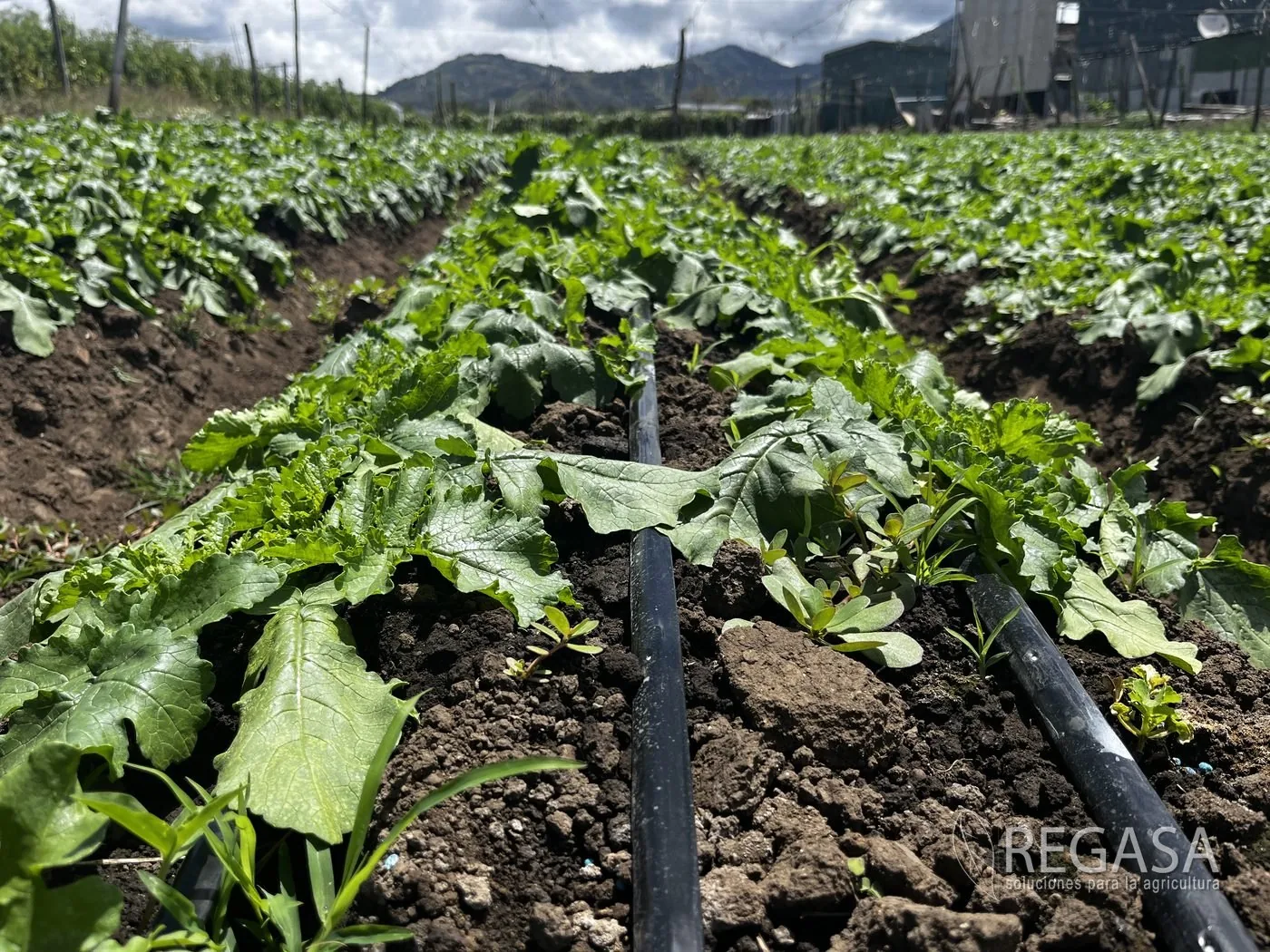
The question comes up constantly from growers setting up irrigation for the first time: drip tape or drip line? The terminology gets used loosely, dealers sell both, and on the surface they look like two versions of the same thing. They’re not.
Both deliver water directly to the root zone. Both reduce evaporation and runoff compared to overhead irrigation. But they’re engineered for different purposes, different crops, and different operating conditions. Getting this decision right before you install saves you from a frustrating and expensive mid-season rework.
What Drip Tape Is
Drip tape is a flat, thin-walled tube, typically between 5 and 15 mils thick, with pre-formed emitter chambers at regular intervals along its length. It lies flat on or under the soil, and water pressure inflates it slightly during operation. When the system shuts off, it collapses back flat.
The design is intended for seasonal or semi-permanent use in row crops. You lay it along your crop rows, use it through the production season, and either pull it at the end of the season or leave it for another cycle depending on the wall thickness and expected durability.
Drip tape is the dominant irrigation method for strawberries, vegetables, and most row crops grown in field or tunnel conditions. Its low profile makes it easy to lay with a mechanical transplanter, it integrates well with plastic mulch systems, and it delivers water uniformly across long runs when the specs are matched correctly to the system design.
What Drip Line Is
Drip line, also called drip tubing, is a rigid or semi-rigid polyethylene tube with independently manufactured emitters either inserted or embedded at intervals. It’s thicker-walled than tape, more durable, and designed for multi-year or permanent installation.
Drip line is what you find in orchards, vineyards, perennial berry plantings, and landscape irrigation where the system needs to stay in place and perform reliably for many years. It handles higher operating pressures than tape, is easier to repair if punctured, and isn’t pulled out and replaced each season.
Inside a commercial greenhouse, drip line is often used for tomatoes, peppers, and cucumbers grown in soilless systems, where the line runs along the growing bags or slabs and stays in place across multiple production cycles.
Choosing by Crop and Production System
For annual row crops in the field or under tunnel, drip tape is almost always the right answer. Strawberries, melons, tomatoes transplanted into the ground, peppers in the field, and leafy greens in bed production all fit the drip tape model. The economics work because the per-foot cost is lower than drip line, and the durability you’re paying for in drip line isn’t necessary when you’re pulling the system each season anyway.
For perennial plantings and permanent production systems, drip line is the better long-term investment. Blueberries, blackberries on a permanent trellis, raspberries in an established planting, and fruit trees need a system that doesn’t require annual removal and reinstallation.
For greenhouse production with soilless growing systems, the choice depends on how the system is set up. Drip line running to individual plants in growing bags or on slabs is standard in high-technology operations. Some smaller greenhouse operations use tape for annual soil-based production cycles.
Specs That Actually Matter
Once you know which product you need, the specs within that product category matter a lot.
For drip tape, wall thickness affects durability and whether you’re planning a single-season or multi-season system. Thinner wall tape is less expensive and appropriate for one season. Heavier wall tape at 10 mils or more can last several seasons with reasonable care.
Emitter spacing determines how water is distributed within the row. For crops with tight root zones like lettuce, closer emitter spacing, around 4 to 6 inches, builds a more continuous wetted zone. For crops with wider spacing like tomatoes or peppers, 8 to 12 inch emitter spacing is typical.
Flow rate per emitter determines how much water the system delivers per hour per unit length. This needs to match your soil type, your run length, and the crop’s water requirement at peak demand. Sandy soils that drain quickly benefit from higher flow rates. Clay soils that move water laterally can work with lower flow rates.
For drip line, emitter flow rate and pressure compensation are the key specs. Pressure-compensating emitters deliver a consistent flow rate across a range of operating pressures, which matters in systems with significant elevation change or long run lengths.
Emitter Design and Clog Resistance
This is where product quality differences become operationally significant.
The emitter channel design determines how resistant the tape or line is to clogging. Standard emitter designs are adequate for clean water sources with good filtration. But many farm water sources have mineral content, algae potential, or particulates that will clog inferior emitters within a season.
Professional-grade tape and line, whose product line includes GreenDrip and BlueDrip, uses emitter channel geometries specifically designed to resist clogging in challenging water conditions. The difference is visible under magnification and measurable in field performance over a full season.
If your water source is clean and well-filtered, the emitter quality difference is less critical. If your water comes from a pond, a surface source, or a well with mineral content, it matters a great deal.
Filtration Is Not Optional
Regardless of whether you’re running tape or line, a properly sized filter is not optional. It’s the primary protection for your emitters and the difference between a system that performs well all season and one that requires constant maintenance.
Disc filters and screen filters are both used in agricultural drip systems. Disc filters generally have better filtration performance for biological material. Screen filters are simpler to clean and adequate for many applications.
The filter needs to be sized for your flow rate. An undersized filter creates pressure drop that reduces system performance. It also clogs faster, requiring more frequent maintenance.
When you’re designing your system, size the filter for the water source you actually have, not the cleanest possible water you might have. The cost of a properly sized filter is minor compared to the cost of losing a crop to emitter failure.
Getting the Design Right
The most common drip irrigation problems, uneven water distribution, emitter failure, and crop inconsistency, are almost always design or installation problems rather than product failures. The system needs to be sized correctly for your field geometry, your water source pressure, and your crop’s water requirements.
If you’re setting up drip irrigation for the first time, or scaling up from a small system to a larger one, it’s worth working with someone who knows how to design systems rather than just selecting components from a catalog.
We design and supply drip irrigation systems for vegetable and berry operations. If you want to talk through what your operation needs, reach out to our team.
What we build
The products behind this article
Want this sized for your farm?
Tell us your crop, your acreage and your state. An advisor comes back with the structure that fits your climate, within one business day. No obligation.
Keep reading