
 Guatemala
  México
  Perú
Perú  Costa Rica
  USA
USA Gothic, Quonset, or Venlo: Which Greenhouse Structure Is Right for Your Operation?
Shape decides how a greenhouse handles snow, sheds rain, moves air and scales. A practical breakdown of the three structure types used commercially.
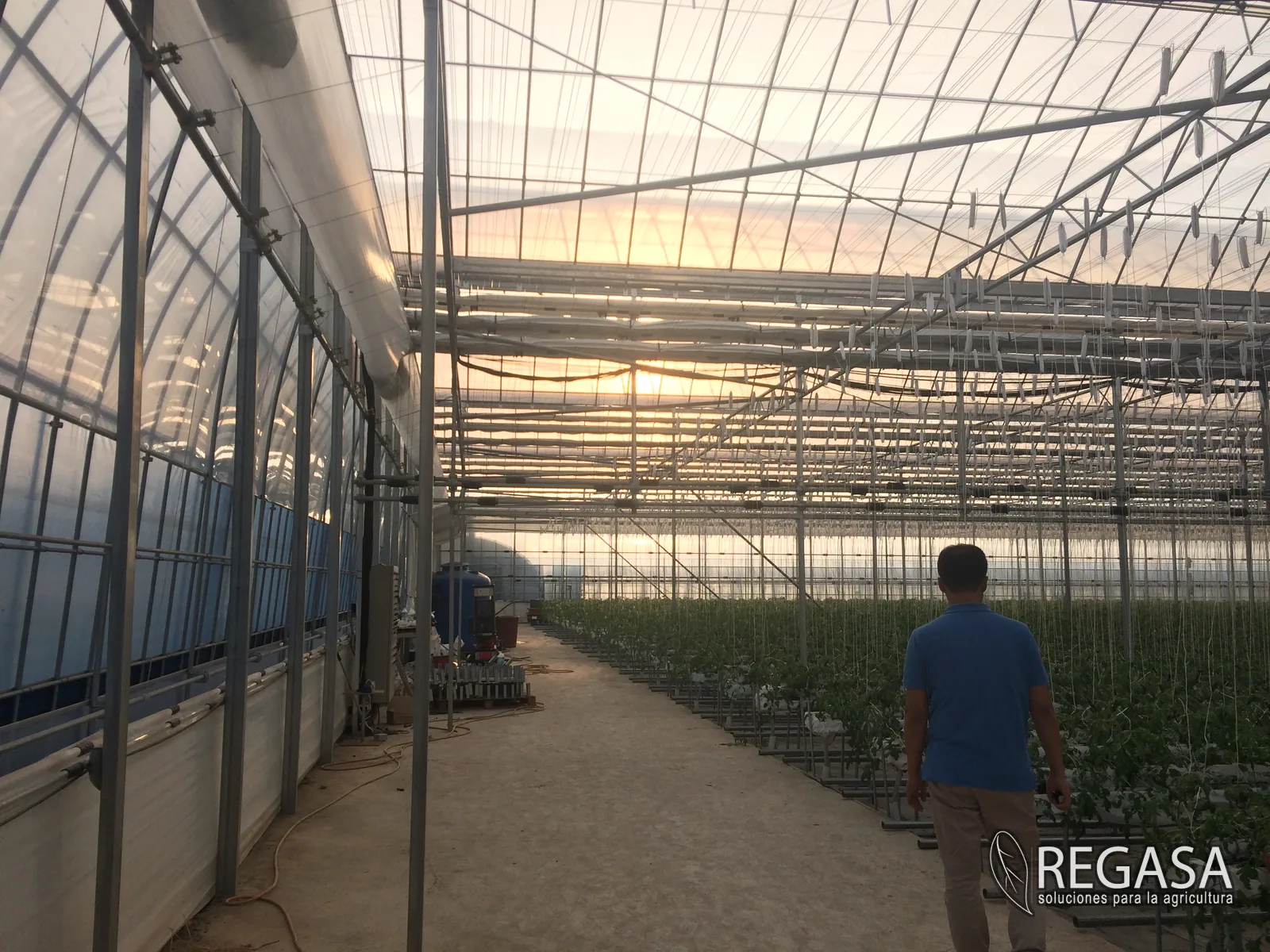
Walk through a commercial greenhouse growing region and you’ll see three basic shapes: the curved arch of a Quonset, the pointed peak of a Gothic, and the flat-ceilinged bays of a Venlo gutter-connected structure. Each shape is a design answer to a different set of priorities. Getting the structure right for your climate, your crop, and your growth plan matters more than most growers realize before they build.
Quonset Structures
The Quonset is the simplest greenhouse form: a semicircular arch made from bent pipe or structural steel. The covering follows the curve of the arch directly, with no vertical sidewalls or complex framing.
The Quonset is inexpensive to build, fast to erect, and widely used for low tunnels, high tunnels, and smaller commercial greenhouses. For a grower who needs covered growing space quickly and at minimum cost, the Quonset form delivers that.
The structural limitation of the Quonset is what happens at the shoulders of the arch. Snow and water can accumulate in that zone under the right conditions, and the sidewall space at bench height is limited because the wall curves inward from the ground. In climates with significant snow, the Quonset’s performance depends heavily on the specific arc geometry and the steel sizing. Shallow arches accumulate snow worse than steeper ones.
Ventilation in a Quonset structure typically relies on roll-up sides and end-wall vents. This is adequate for many operations, particularly seasonal ones, but it limits the precision of climate control in extreme conditions.
Quonset structures are most appropriate for seasonal high tunnel and hoop house production, smaller operations where capital cost is the primary constraint, and crops that don’t need sophisticated environmental control.
Gothic Arch Structures
The Gothic arch modifies the Quonset form by introducing a pointed peak at the top. The shape looks like the arch you’d find in a Gothic cathedral, which is where the name comes from.
The pointed peak does something specific: it sheds snow and rain more effectively than a rounded arch because water can’t pool at the apex. In snow-prone climates, Gothic structures shed load better than equivalent Quonsets. The steeper pitch also creates more headroom at the center of the structure without increasing the overall footprint.
The sidewall issue that affects Quonsets is less severe in Gothic structures, though not entirely eliminated. Depending on the height of the sidewall section before the arch begins, you can get more usable vertical space near the edges of the structure.
Gothic arch structures are used for both tunnel production and commercial greenhouses. They perform well in climates with moderate to significant snow and rain, and they’re generally easier to justify than a Venlo for single-bay commercial applications.
For growers considering a structure that will handle real winters, produces well in spring and fall shoulder seasons, and costs less than a Venlo system to install, the Gothic arch is often the right answer.
Venlo Structures
The Venlo is a gutter-connected commercial greenhouse system originally developed in the Netherlands. Instead of a single arch, Venlo structures are made of repeating bays connected at shared gutters, with a characteristic peaked roof profile within each bay.
The key advantage of gutter-connected Venlo construction is scalability. You can add bays to a Venlo structure as your operation grows, and the interior of a multi-bay Venlo is a single continuous space without the internal support walls you’d need if you were connecting separate Quonset or Gothic structures. Large commercial operations, from two acres to tens of acres under cover, almost always use some form of gutter-connected structure.
Venlo structures are also extremely adaptable for full climate control. The design supports mechanical ventilation, heating distribution, shade curtains, humidity management systems, and automated environmental controls in a way that free-standing Quonset or Gothic structures don’t accommodate as naturally.
The tradeoff is cost and complexity. Venlo structures require more sophisticated engineering, more steel, and more planning than a Quonset or Gothic structure of comparable area. They’re also more expensive per square foot for a small installation, though the economics per square foot improve as the total size increases.
Snow management in Venlo structures requires careful design. The gutters between bays can accumulate snow and ice, and drainage systems need to be part of the design. In high-snowfall areas, structural specifications need to reflect the actual snow load for your location.
How to Choose
Start with climate. If you’re in a warm or mild climate where snow is rare and the goal is extending your season or protecting crops from rain, a Quonset or Gothic tunnel gets you where you need to be at the lowest cost.
If you’re in a climate with meaningful snowfall and you need the structure to perform year-round, the Gothic form handles snow better than the Quonset and is worth the modest additional cost.
If you’re building a production greenhouse that will operate year-round in any climate, you need to be growing at a scale that justifies it, or you’re planning to grow to that scale, a Venlo or similar gutter-connected structure gives you the climate control capability and scalability that tunnel structures can’t match.
Production type matters too. Strawberries and vegetables in seasonal production are well-suited to Gothic and Quonset tunnels. Year-round tomatoes, cucumbers, and peppers in a controlled-environment system belong in a more substantial structure.
The decision isn’t just about what you need today. Think about where your operation is in five years and whether the structure you build now positions you to get there.
If you’re working through this decision for a specific project, our team is glad to talk through the tradeoffs for your climate and crop. Reach out and we can help you evaluate the options.
What we build
The products behind this article
Want this sized for your farm?
Tell us your crop, your acreage and your state. An advisor comes back with the structure that fits your climate, within one business day. No obligation.
Keep reading