
 Guatemala
  México
  Perú
Perú  Costa Rica
  USA
USA High Tunnel vs. Multi-Bay Tunnel vs. Commercial Greenhouse
Single-span high tunnel, gutter-connected multi-bay, or full greenhouse. What each one does, who it fits, and how to choose without overbuying.
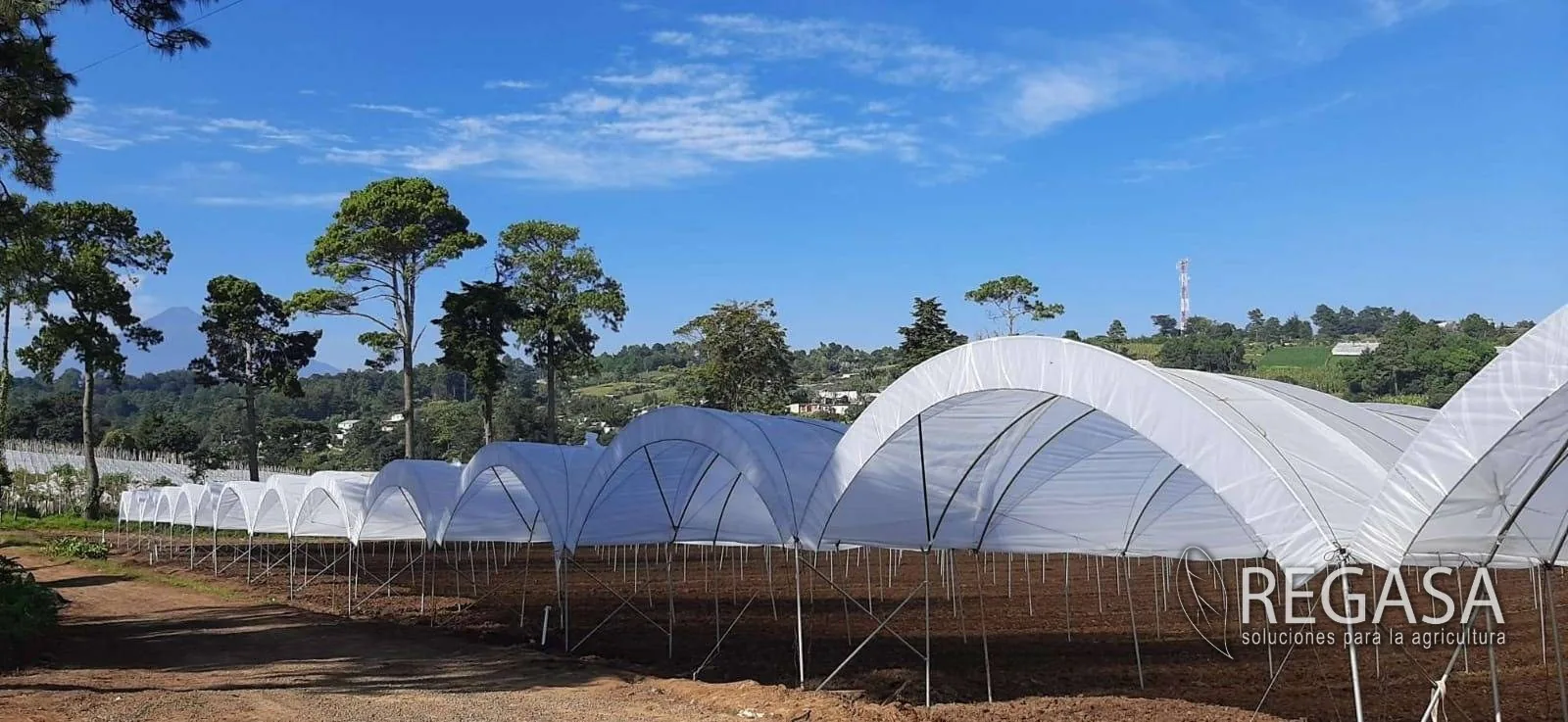
Walk into any farm conference in the U.S. and you will hear growers use “high tunnel,” “hoop house,” and “greenhouse” almost interchangeably. Two of those are the same thing. The third is not, and there is a fourth option in between that most growers never hear about until someone shows them one.
First, the vocabulary, because it causes more confusion than anything else. High tunnel and hoop house mean the same structure. In Spanish speaking markets the same thing is called a macrotúnel. One arch, walk-in height, crops in your own soil. Different words, one structure.
What actually differs is how many of those arches you join together, and whether you add climate control.
This article breaks down the real differences so you can make a decision based on your farm, your crop, and your goals.
Start With the Question That Actually Matters
Before comparing structures, ask yourself one thing: what problem are you trying to solve?
Are you trying to protect berries from rain and get three extra weeks of harvest? Are you trying to grow tomatoes twelve months a year? Are you dealing with extreme weather that’s cutting into your yields every season?
The answer tells you which direction to go before you even look at specs.
What Is a High Tunnel?
A high tunnel is the simplest structure in the family. It’s a metal frame covered with polyethylene plastic film, typically tall enough to walk through and work in. You can ventilate it by rolling up the sides or opening the ends.
High tunnels are excellent for season extension. They don’t require a heating system (though you can add one), and installation is straightforward enough that many operations put them up without outside help. They’re also the structure most commonly covered by NRCS grant programs, which is a big reason they’ve taken off in the U.S. over the last decade.
What they’re not great at is precision climate control. If you need to hit a specific temperature range year-round, a high tunnel will struggle in extreme cold or heat without significant additional investment.
Good fit for: Berry production, cool-season vegetables, cut flowers, small operations testing protected agriculture for the first time.
What Is a Multi-Bay Tunnel?
This is the option that sits between a single high tunnel and a full greenhouse, and the one most growers have never had explained to them.
A multi-bay tunnel, also called gutter-connected, is several tunnel arches joined side by side sharing a common gutter. You still get walk-in height and crops in the ground, but instead of separate structures with wasted alleys between them, you have one continuous covered area.
What that buys you is real. You lose the dead space between freestanding tunnels, so more of your footprint grows crop. Equipment moves through the whole block without going outside. The larger shared air volume rides out temperature swings better than a single arch does. And you can expand by adding bays instead of building something new.
Strawberry and berry growers have adopted these widely for exactly that reason: the harvest window extends the same way a single tunnel does, but the operation scales without multiplying the headaches.
The tradeoff is that a gutter carries snow and water load from two roofs at once, so the engineering is more demanding and the frame costs more per square foot than a standalone tunnel.
Good fit for: Strawberries, blueberries, raspberries, cut flowers. Operations past their first tunnel that want to scale covered area without jumping to full climate control.
What Is a Commercial Greenhouse?
A commercial greenhouse is in a different category entirely. We’re talking about a permanent structure engineered for controlled-environment agriculture. That means managing temperature, humidity, CO2 levels, light, and irrigation all within a closed or semi-closed system.
The crops grown in commercial greenhouses don’t just have a longer season, they produce year-round, at yields that field farming can’t come close to. Tomato yields in a well-managed greenhouse can be ten times what you’d get from the same area in an open field. That math changes what’s financially possible for a farming operation.
The tradeoff is that you’re committing to a real infrastructure project. A commercial greenhouse requires engineering, site preparation, a heating and cooling strategy, irrigation design, and trained management. It’s not something you prototype, you build it to scale and run it as a business.
Good fit for: Tomatoes, cucumbers, peppers, leafy greens, herbs, flowers. Operations with clear market access (retail contracts, food service, direct-to-consumer) and the management capacity to run a controlled-environment system.
How to Choose
Here’s a simple way to think about it.
If your goal is to protect an existing field crop and extend its season by a few weeks or months, start with a single-span high tunnel. It is proven, it pays back fast, and it does not require reorganizing how you farm.
If you are ready to scale covered acreage but not ready for climate control, multi-bay is the step. You gain growing area and easier operation without taking on a controlled environment.
On NRCS: the program funds high tunnels specifically, with crops grown in the natural soil profile and no heating. That points you at the tunnel side of this comparison, not the greenhouse side.
If you’ve identified a year-round crop market and have the infrastructure and management team to run a full controlled-environment operation, a commercial greenhouse is the right move. The investment is larger, but so is the production capacity and the income potential.
Plenty of farms run all three. Single-span tunnels on the berry rows, a multi-bay block for the main covered acreage, and a greenhouse for the year-round tomato and cucumber operation. They solve different problems, and the mistake is buying the expensive one to solve a problem the cheap one already handles.
One More Thing Worth Knowing
The structure is only part of what makes protected agriculture work. Irrigation, covering material, ventilation design, and the technical support behind the product matter just as much as the frame.
We have been designing and installing these structures for over 30 years, and what separates the operations that work from the ones that struggle is almost never the frame. It is whether the covering, the ventilation and the irrigation were matched to that particular site.
Before you decide, look at the high tunnel specifications and the commercial greenhouse page, or check what we recommend for your state.
If you’re ready to figure out which structure fits your operation, reach out to our team. We’ll ask you the right questions and point you in the right direction without the sales pressure.
What we build
The products behind this article
Want this sized for your farm?
Tell us your crop, your acreage and your state. An advisor comes back with the structure that fits your climate, within one business day. No obligation.
Keep reading