
 Guatemala
  México
  Perú
Perú  Costa Rica
  USA
USA Polycarbonate vs. Polyethylene Film: Choosing the Right Greenhouse Covering
Your covering decides light transmission, thermal performance, durability and operating cost for the life of the greenhouse. A straight comparison.
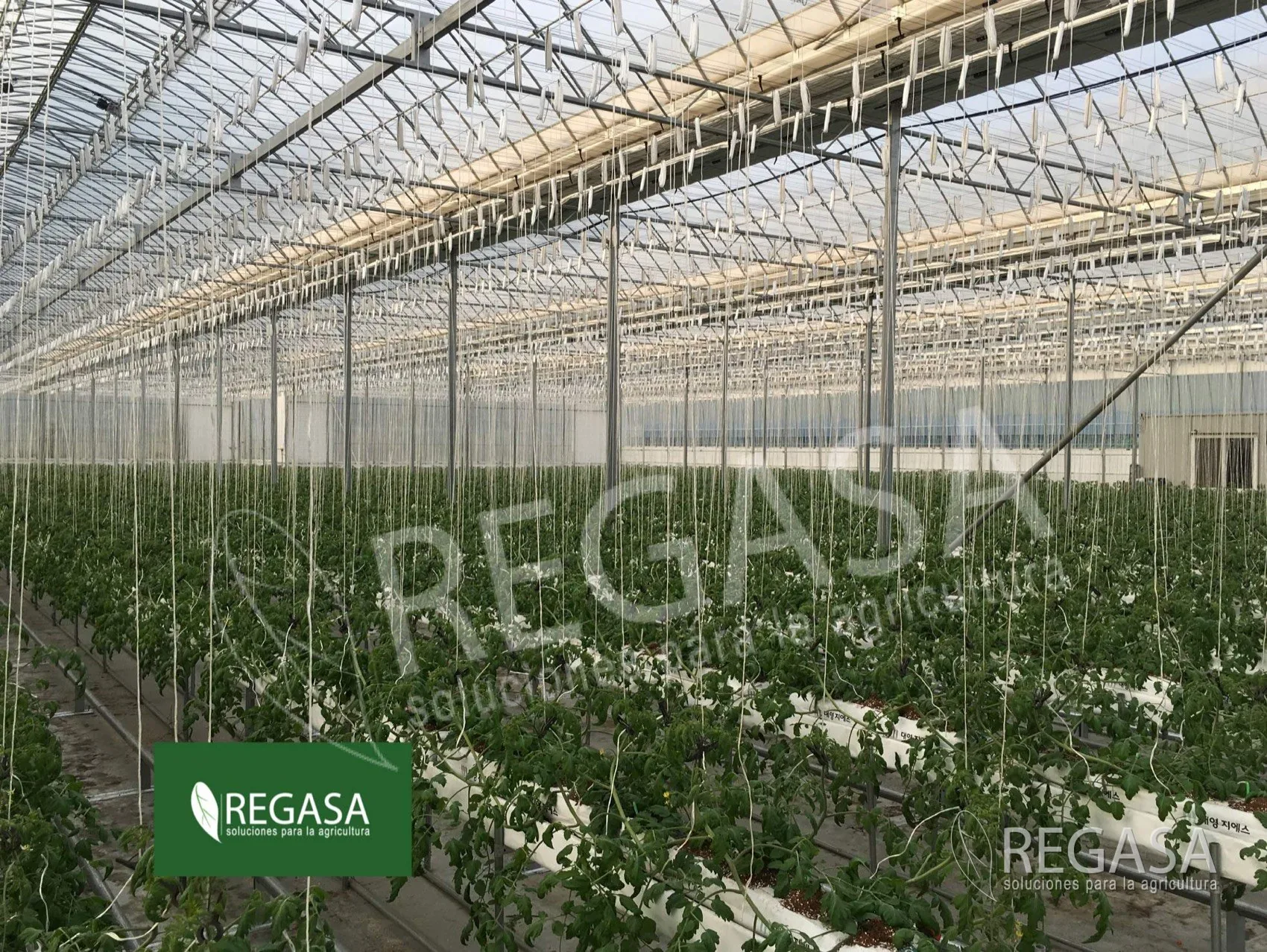
The frame of a commercial greenhouse gets a lot of attention. The covering doesn’t get nearly enough. That’s backwards. The covering is what the plants actually respond to. It determines how much light reaches the crop, how well the structure retains heat at night, and how long you’ll go before you’re paying to replace it.
Polycarbonate panels and polyethylene film are the two options you’ll seriously consider for most commercial greenhouse applications. They’re different in almost every way that matters. Here’s an honest look at both.
Polyethylene Film
Polyethylene (poly) film is the most widely used covering for commercial greenhouses and tunnels in the U.S. and globally. It’s a flexible plastic sheeting applied over the frame of the structure, typically in one or two layers.
The primary advantage of poly film is light transmission. High-quality diffuser poly transmits 85 to 92 percent of available light to the crop. That number is not just about total light quantity. Diffuser films scatter light in ways that reach the lower canopy of the plant, reducing shadowing and improving light distribution within the canopy. Studies consistently show that crops under diffuse light covering outperform crops under the same total light with direct transmission.
Good poly film is also meaningfully cheaper than polycarbonate panels, which affects both your initial investment and your ongoing replacement costs.
The honest limitation is that poly film needs to be replaced. Standard greenhouse poly has a rated lifespan of four years under normal conditions. In intense UV environments like the southern U.S., high-altitude growing areas, or locations with extreme temperature cycling, degradation can happen faster.
Replacement is not catastrophic, and experienced greenhouse operators budget for it. But it is a recurring cost and an operational interruption that polycarbonate doesn’t require on the same schedule.
Polycarbonate Panels
Polycarbonate is a rigid plastic panel system, most commonly used in twin-wall or multi-wall configurations where air spaces between the layers provide insulation. It’s attached to the frame permanently rather than stretched over it.
The insulation value of polycarbonate is its main advantage. Multi-wall polycarbonate retains significantly more heat than a single layer of poly film, which reduces heating costs in cold climates. For year-round operations in northern states where heating is a major operating expense, this can make a meaningful difference in your energy budget.
Polycarbonate panels are more durable than poly film and don’t require replacement on the same schedule. A quality polycarbonate installation can last 10 to 15 years or more if the panels are properly maintained and the UV coatings hold up.
The tradeoff is light transmission. Polycarbonate panels, even high-quality ones, transmit less light than good poly film. The multi-wall construction that provides insulation also means more light is blocked by the panel structure. In low-light conditions, this can affect crop performance, especially in winter.
Polycarbonate is also more expensive than poly film for the initial installation. The higher upfront cost is partly offset by the longer replacement interval, but the capital outlay is larger initially.
Which One to Choose
The decision usually comes down to two questions: how cold is your winter, and what do you value more in the covering?
In warm and mild climates where winter heating is minimal, the insulation advantage of polycarbonate matters less. The superior light transmission of diffuser poly film is often the more valuable characteristic, and the lower cost makes the economics clear. Most commercial greenhouses in the southern U.S., California, and similar climates use poly film.
In cold climates where heating represents a significant portion of your operating cost, the insulation value of polycarbonate deserves serious consideration. If reducing your heating bill by 20 to 30 percent changes your year-round production economics meaningfully, that’s worth paying attention to.
A common approach in cold-climate greenhouses is double-layer poly film with an inflation system that creates an air gap between the layers. This captures most of the insulation benefit of multi-wall polycarbonate at a lower cost and with better light transmission. It requires replacing both layers when they degrade, but it performs well in practice and is widely used.
The Plastic Quality Question
Within the poly film category, quality varies significantly. Agricultural-grade poly film ranges from basic single-layer sheeting to engineered multi-functional films with UV stabilizers, anti-drip coatings, thermal retention additives, and specific diffusion properties.
The cheapest poly film is cheap for a reason. It degrades faster, loses light transmission properties before it visually appears degraded, and doesn’t have the performance characteristics of quality engineered films.
Good greenhouse poly from manufacturers who engineer specifically for agricultural applications, with known UV ratings and documented optical properties, performs very differently from generic plastic sheeting. The cost difference is real but manageable relative to the performance difference.
When you’re evaluating films, ask specifically about the UV stabilizer content (expressed in hours of UV resistance testing), the light diffusion angle, and what the warranted lifespan is under your expected conditions.
Covering Replacement Planning
If you’re using poly film, plan your replacement cycle from day one. Know when your film was installed, what its rated lifespan is in your climate, and what the replacement cost looks like. Budget for it annually even if you don’t replace it every year.
Replacing poly is best done in mild weather when the film is workable and the temperature differential between inside and outside the structure is not extreme. Spring or fall, depending on your climate, is typically the easiest time to manage a re-covering project.
If you’re in the planning phase for a new greenhouse and have questions about covering options for your specific climate and crop, that’s worth discussing before you commit to a design. Reach out to our team and we can walk through what makes sense for your situation.
What we build
The products behind this article
Want this sized for your farm?
Tell us your crop, your acreage and your state. An advisor comes back with the structure that fits your climate, within one business day. No obligation.
Keep reading