
 Guatemala
  México
  Perú
Perú  Costa Rica
  USA
USA The US Drip Tape Market: What Growers Should Know Before Buying
Drip tape looks like a commodity and is not. Wall thickness, emitter spacing and flow rate move your cost per acre more than price per foot does.
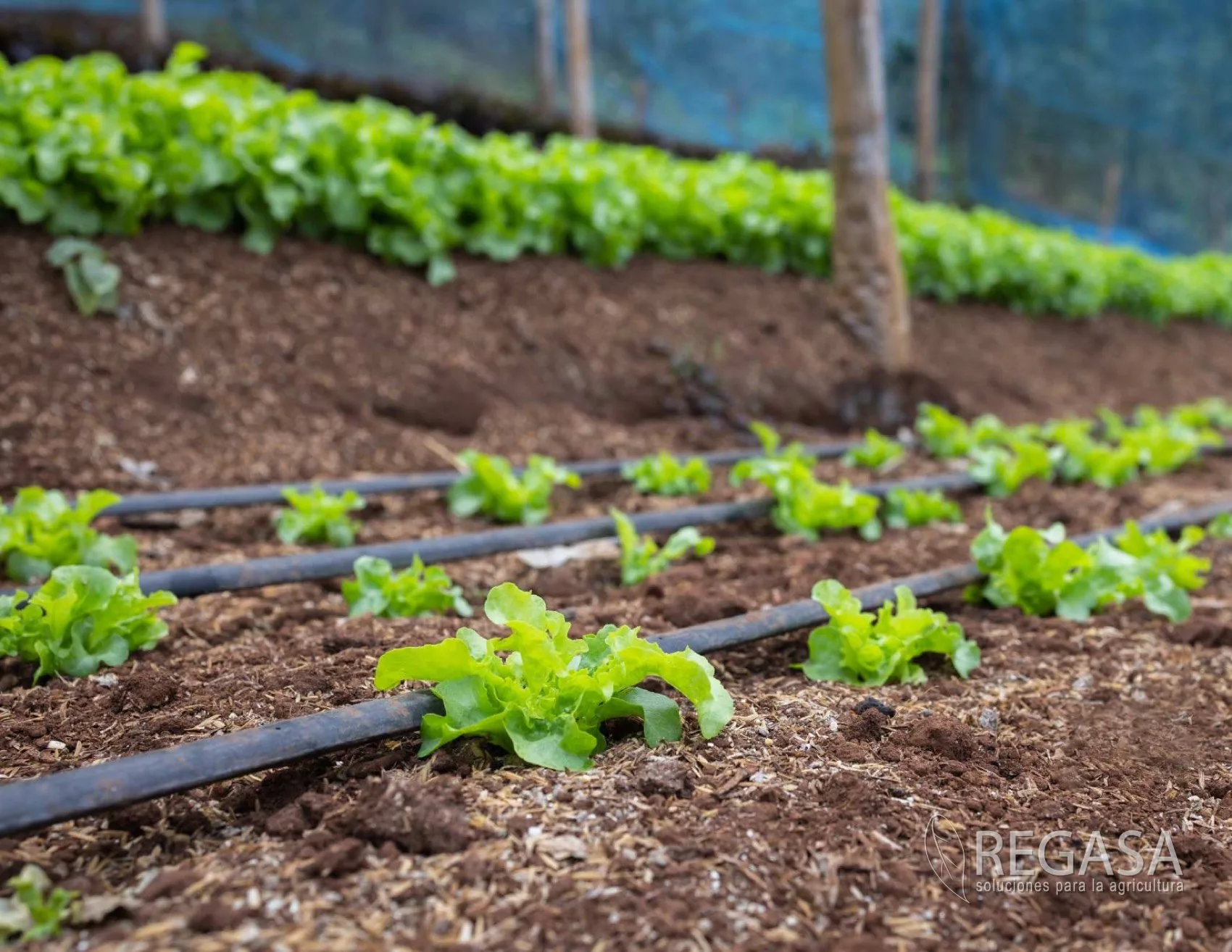
Drip tape is sold like a commodity. Price per foot, delivered, next question. That framing costs American growers real money every season, because the cheapest tape per foot is frequently the most expensive tape per acre per year.
Here is how the market actually works and what to compare before you sign anything.
The four specs that decide everything
Every roll of drip tape is described by four numbers. Get these right and price becomes a genuine comparison. Get them wrong and you are comparing products that do different jobs.
Wall thickness, measured in mil
This is the single biggest driver of how long the tape lasts and how much abuse it takes.
Thin wall tape, in the 5 to 8 mil range, is built for one season. It is thinner, lighter, cheaper per foot, and it will not survive rough handling, retrieval and redeployment. For short cycle vegetables where you pull it up at the end of the season anyway, that is exactly right and paying for more is waste.
Thicker wall, in the 8 to 15 mil range, survives multiple seasons, handles being walked on and dragged, and holds up to prolonged UV exposure. For a perennial crop or a long cycle under cover, the higher price per foot spreads across several harvests and ends up cheaper.
The question is never “which is thicker.” It is “how many seasons will this tape work, and what is my cost per season.”
Emitter spacing
How far apart the drippers sit, typically between 4 and 12 inches.
Closer spacing gives you a continuous wetted strip, which is what sandy soil and shallow rooted crops need, because water moves down faster than sideways in sand. Wider spacing works in clay and heavier soils where water spreads laterally and individual emitters overlap on their own.
Choosing spacing without knowing your soil texture is guessing. A soil test costs almost nothing and settles it.
Flow rate
How much each emitter delivers per hour. Lower flow lets you run longer lines and irrigate more area per zone with the same pump. Higher flow gets water down faster but limits run length.
This interacts with your pump, your filtration and your block layout. It is the spec most often chosen by default and most often wrong.
Roll length
The unglamorous one that changes your labor bill.
Longer rolls mean fewer connections, fewer fittings and less installation time. On any meaningful acreage the labor difference between short and long rolls is a real number, and with labor costs where they are in 2026 it is a growing one.
What separates suppliers
Once the specs are matched, here is what actually differs.
Emitter design and clog resistance. The labyrinth inside the emitter is what keeps particles moving through instead of settling. A wide inlet filter and a turbulent flow path are what you want. This is invisible on a spec sheet and shows up in year two as blocked rows.
Flow uniformity along the run. Good tape delivers nearly the same amount at the last emitter as the first. Poor tape does not, and you get a crop that is visibly better at one end of the field. If a supplier cannot tell you the uniformity, that is an answer.
UV stabilization. Tape sits in the sun all season. Stabilization is what keeps it from going brittle. It is also easy to skimp on and impossible to see.
Availability and lead time. A supplier who cannot deliver in planting week is not a supplier. This matters more than most growers weigh it until the year it goes wrong.
The comparison that actually matters
Stop comparing price per foot. Compare cost per acre per season.
That calculation needs four inputs: the price, the row spacing that determines how many feet per acre you need, the number of seasons the tape will realistically last, and the installation labor, which is driven by roll length and fitting count.
Run that and thin wall tape frequently wins for short cycle vegetables, while thicker wall wins clearly for anything perennial or under cover. The point is that the answer changes by crop, and price per foot alone will never tell you which case you are in.
Two products, two jobs
We supply two lines because the market has two genuinely different needs.
GreenDrip is the multi season line. Heavier wall, built to work several cycles with uniform flow from the first foot to the last. It is the choice for demanding crops, for anything perennial, and for export operations where uniformity across the block is not negotiable.
BlueDrip is the short cycle line. Lighter wall, precise where it counts, and it lets you cover more ground on the same budget. It is built for vegetables on a 30 to 90 day cycle and for operations that want maximum acreage per dollar.
Neither is better. They answer different questions. Full specifications on the drip tape page.
Before you order
Know your soil texture, because it sets your emitter spacing. Know your water source and its filtration needs, because that decides whether your emitters survive. Know your crop cycle length, because that decides your wall thickness. And know your row spacing, because that is what turns price per foot into cost per acre.
Come to a supplier with those four and you will get a real recommendation instead of a price list.
If you want that conversation, tell us what you grow and where through the project form.
What we build
The products behind this article
Want this sized for your farm?
Tell us your crop, your acreage and your state. An advisor comes back with the structure that fits your climate, within one business day. No obligation.
Keep reading