
 Guatemala
  México
  Perú
Perú  Costa Rica
  USA
USA How to Choose a Drip Tape Supplier
Price per foot is the easiest thing to compare and the least useful. What actually separates suppliers is consistency, availability and what happens mid-season.
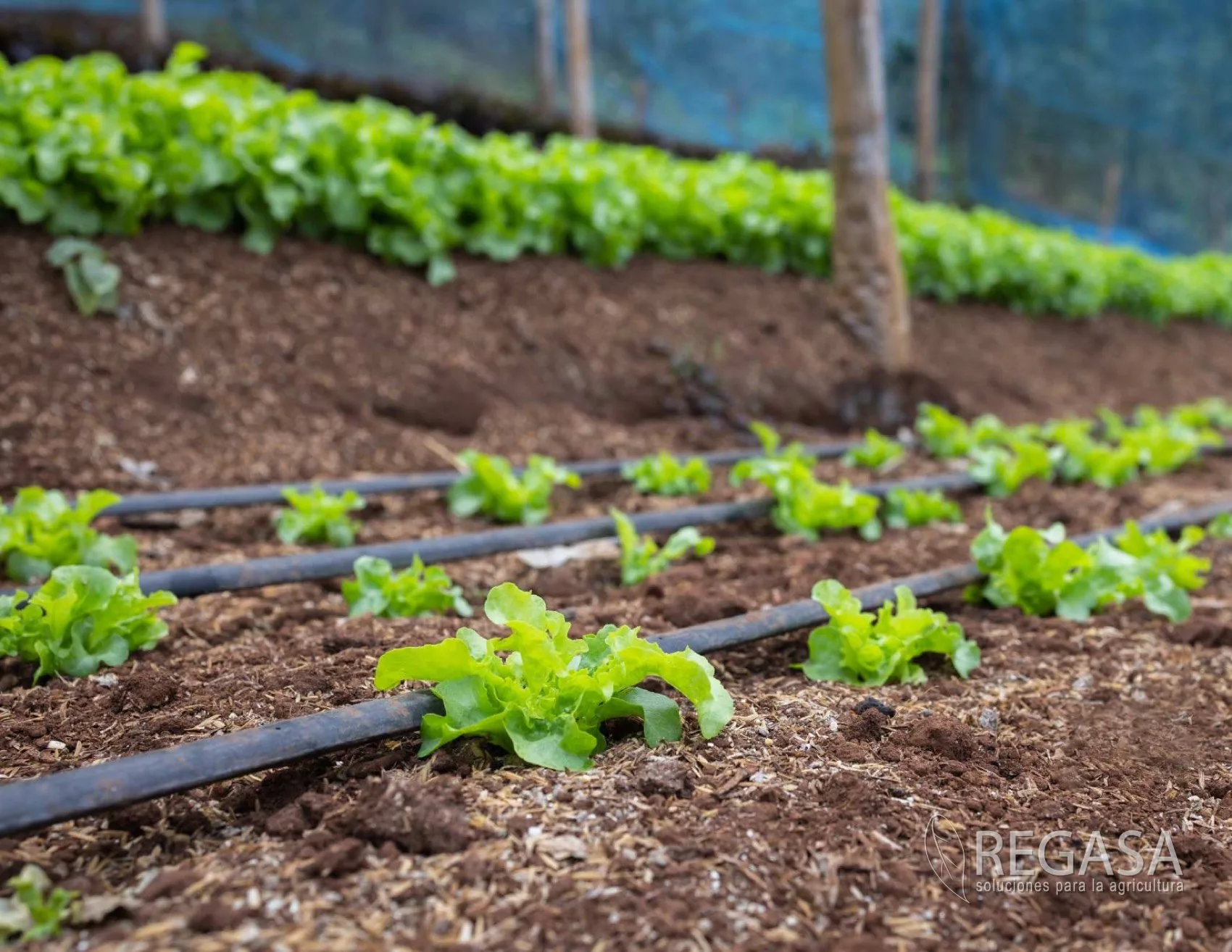
Price per foot is the easiest thing to compare between drip tape suppliers and the least useful.
The tape is a component in a system that has to run every day of the season without you thinking about it. What separates suppliers is not the number on the invoice, it is whether the roll performs the same from one end to the other, whether they have stock when you need it, and what happens when something goes wrong in week six.
Here is what to actually ask.
Ask about the emitter, not the tape
The tape is a tube. The emitter inside it is the product.
What is the emitter, and who makes it? A drip line is only as good as the component metering the water. We build ours around Metzerplas emitters, which is a component specification, not a marketing line, and any supplier should be able to tell you the same thing about theirs without hesitating.
What is the flow rate, and how uniform is it along the run? Two rolls with the same nominal rate can behave very differently at the far end of a long run. Uniformity is the whole point of drip, and it is what you are paying for.
Is it pressure-compensating? On flat ground with short runs, usually not necessary. On slope, or with long runs, it is the difference between a crop that finishes evenly and one that does not.
Ask about the specifications you actually choose
Four of them, and they interact.
Wall thickness. Determines how many seasons a roll survives and how much handling it tolerates. Thin wall is for a single short cycle. Thicker wall is for multiple seasons or rocky ground. Buying thin to save on the invoice and replacing it annually is often the more expensive path.
Emitter spacing. Matched to your soil and crop. Sandy soil wets a narrow column and needs closer spacing; heavier soil spreads laterally and tolerates wider. Get this wrong and you get dry gaps between plants regardless of how much water you run.
Flow rate. Determines how long a set takes and how many zones your water supply can serve at once.
Roll length. Affects how many connections you make per acre, which affects installation labor and the number of potential leak points.
Together these move your real cost per acre far more than the price per foot does. We went through the arithmetic in the US drip tape market guide.
Ask about availability, which is the question nobody asks
Do you stock it, or do you order it?
This is the question that matters most in practice and gets asked least. Drip tape is not something you can wait three weeks for. If a run gets damaged during cultivation in the middle of the season, you need replacement now, and a supplier who orders on demand cannot help you.
Do you carry the same specification next year? Mixing wall thicknesses and emitter spacings across a field turns your irrigation scheduling into guesswork. A supplier who changes what they carry every season creates a problem you did not have.
Ask what happens when it fails
Not if. Drip tape gets cut by cultivation, chewed by rodents and plugged by whatever your water carries.
What is the repair path? Couplers and repair fittings should be standard, available and cheap. Proprietary fittings you can only get from one place are a liability.
What filtration do you recommend for my water, and did you ask to see a test? A supplier who quotes a drip system without asking about your water is quoting a guess. Iron, hardness and particulate all plug emitters, and each needs different filtration.
What is the flush procedure? Systems need periodic flushing and manifolds need to be designed to allow it. If nobody mentioned flushing, nobody designed for it.
Ask what else they can size
Drip tape does not work alone. It needs the right pressure at the head, filtration matched to your water, mainline sized for your flow, and a manifold you can actually flush.
A supplier who sells rolls and nothing else leaves you to assemble the system. A supplier who sizes the whole thing is doing the part that determines whether it works.
The layflat line is often the missing piece. See layflat hose for moving volume from the source to the field with fewer connections.
The tell
Change one input and see whether the recommendation changes.
Tell them your soil is sand instead of clay. If the emitter spacing they recommend does not move, they were never specifying it. Tell them your rows run 900 feet instead of 300. If the flow rate and the pressure compensation do not come up, they are selling from a shelf.
A supplier who asks about your soil, your row length, your slope, your water and your crop before quoting is doing engineering. One who asks how many feet you need is doing retail.
What we carry
Two lines, because two different jobs.
GreenDrip is built for multiple seasons: thicker wall, for growers who install once and run it for several cycles.
BlueDrip is built for short-cycle vegetables where the tape comes out with the crop.
Both are specified around the emitter, both are stocked rather than ordered, and both come sized to your soil, row length and water rather than to a default. See GreenDrip and BlueDrip drip tape.
If fertigation is part of the plan, the line is where it goes. See why fertigation pays back faster now.
Where to start
Send us your soil type, your row length and a water test if you have one. If you do not have a water test, get one before you buy anything, from any supplier. It is the cheapest step in the whole project and it determines several of the others.
What we build
The products behind this article
Want this sized for your farm?
Tell us your crop, your acreage and your state. An advisor comes back with the structure that fits your climate, within one business day. No obligation.
Keep reading