
 Guatemala
  México
  Perú
Perú  Costa Rica
  USA
USA Fertilizer Up 37%: Why Fertigation Pays for Itself Faster Now
When an input gets more expensive, precision on that input gets more valuable. The case for feeding through the drip line changed when fertilizer prices did.
Fertilizer cost US growers roughly 37% more in 2025 than in 2020.
That single number changes an investment decision that a lot of operations had parked. Fertigation was always a good idea in principle and a hard sell in practice, because the equipment costs money and broadcasting works well enough.
Broadcasting works well enough when fertilizer is cheap. The arithmetic moved.
The principle nobody argues with
When an input gets more expensive, precision on that input gets more valuable.
Waste that was tolerable at one price stops being tolerable at another, and the equipment that eliminates the waste pays back proportionally faster. Nothing about the technology changed. What changed is what you are wasting.
Where broadcast fertilizer actually goes
Not all of it reaches a root. That is not a criticism of the method, it is physics.
Some of it goes where nothing is growing. Broadcast covers the ground; roots occupy a fraction of it.
Some leaches past the root zone. Especially in sandy soil, especially after rain, especially with the mobile nutrients that matter most.
Some is applied at the wrong moment. A crop’s demand is not flat across the cycle. Broadcast delivers a large dose when you apply it, not when the plant asks.
Some runs off. Slope and rain.
Every one of those was money before. Now each is 37% more money.
What feeding through the line changes
Fertigation puts nutrients in the irrigation water, which means they arrive where the roots already are, because that is where the water goes.
Three things follow.
Placement. Nutrients land in the wetted zone, which is the root zone. Very little goes where nothing is growing.
Timing. You feed to the growth stage instead of front-loading the season. Nutrient demand curves are real and broadcasting cannot follow one.
Rate control. Small, frequent doses instead of large infrequent ones. Less sitting in the soil waiting to leach.
The result is the same crop on less fertilizer, or a better crop on the same fertilizer. Which of the two you take is a business decision.
The environmental case became the financial case
Less fertilizer applied means less leaching into groundwater. That used to be an argument you made to a regulator or a retail buyer.
Now it is the same argument you make to your accountant. What leaches is what you paid for and did not use, and it costs 37% more than it did.
The two cases converged, which is unusual and worth noticing.
Why it works better under cover
Fertigation and protected growing reinforce each other.
Rain does not rewrite your program. Under cover you control the water, so a storm does not leach what you applied yesterday. In the open field, weather can undo a feeding.
Drip is already there. If you are growing under cover you almost certainly have drip. The line exists; fertigation adds injection to it. The incremental step is much smaller than starting from scratch.
The crop is worth more. Protected crops are typically higher value, so the return on precision is higher per acre.
The honest part: it needs scale
This is the piece suppliers skip.
Fertigation has fixed capital: the injector, the controller, the plumbing, sometimes filtration and a mixing tank. That cost spreads across your area.
On a small plot, mixing and applying by hand is fine, and the equipment will not pay back in a reasonable time. Past a certain size that stops being true, and the threshold moved down when fertilizer prices moved up. Where exactly the line falls depends on your crop and your area.
You also need someone who understands what they are dosing. The equipment does not make agronomic decisions. Automating a bad feeding program gets you a consistently bad feeding program.
How to decide
Three questions.
What did you spend on fertilizer last season? Not per acre, total. That is the pool the savings come out of.
What fraction realistically did not reach a root? Nobody knows this precisely, but you know your soil, your slope and your rain.
What would the equipment cost for your area? Real numbers, not an estimate.
That is the whole calculation, and it is one an accountant can check. It will also be far more convincing to a lender than any manufacturer’s claim.
Where to start
If you do not have drip yet, that comes first. Fertigation without drip is not a thing. See GreenDrip and BlueDrip.
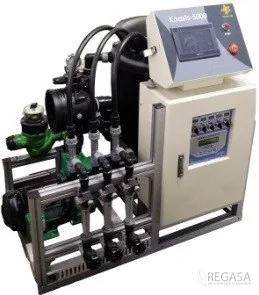
If you have drip and are mixing by hand, that is exactly the operation this is for. Automated fertigation control is the piece that turns the structure into a system.
If you are planning a new structure, design the fertigation in from the start. Retrofitting is always more expensive than including it.
We put this in the wider context of what to automate first in where automation actually pays.
Input cost changes come from American Farm Bureau Federation market analysis of 2020 to 2025.
What we build
The products behind this article
Want this sized for your farm?
Tell us your crop, your acreage and your state. An advisor comes back with the structure that fits your climate, within one business day. No obligation.
Keep reading