
 Guatemala
  México
  Perú
Perú  Costa Rica
  USA
USA Where Automation Actually Pays in a Greenhouse
Growers rank harvest technology first and irrigation second. The returns run the other way around. Here is the order automation actually pays back in.
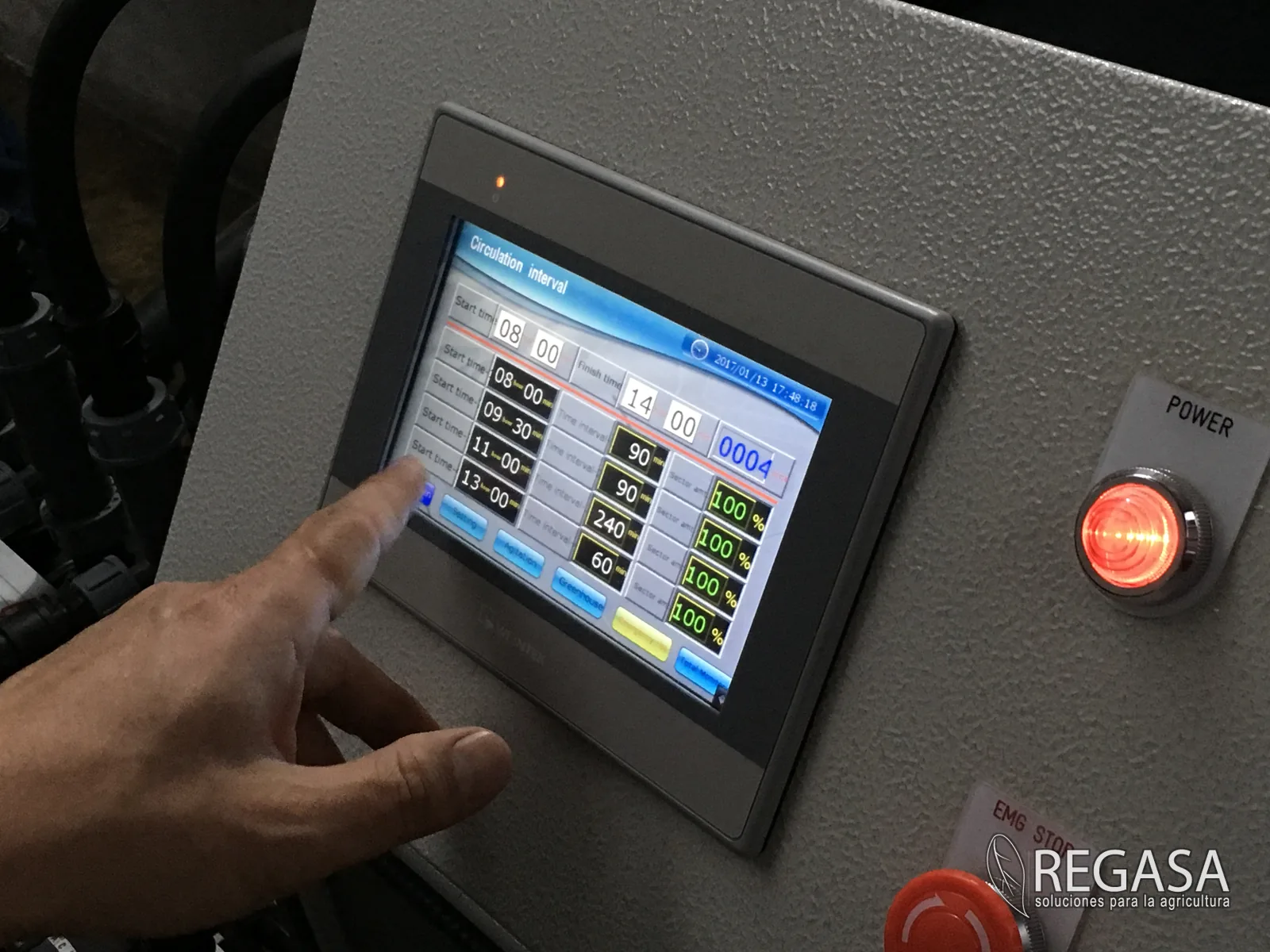
Ask growers what they want to automate and harvesting comes first, irrigation second.
Ask what actually paid back, and the order reverses.
Harvest is the biggest labor line, so it is the obvious target. But obvious and profitable are not the same thing, and the gap between them has cost a lot of operations a lot of money.
Here is the honest order.
First: irrigation and feeding
This is not close.
It runs every single day. A system that operates 300 times a season has 300 chances to return value. A harvest robot works a few weeks.
Small errors compound invisibly. Slightly too much water, slightly the wrong feed, every day for a whole cycle. By the time you see it in the crop, you have lost the cycle. Nobody notices a 10% irrigation error on any given Tuesday.
The technology is mature and boring. Timers, valves, injectors, sensors. Proven, serviceable, and if it breaks you can fix it or find someone who can.
The failure mode is safe. A controller that goes down means irrigating manually for a day. A harvest robot that goes down during peak means a crisis.
Automated fertigation is where a structure stops being a building and becomes a system. With fertilizer up roughly 37% since 2020, precision on an expensive input pays faster than it used to.
See fertigation control for what this looks like in practice, and why fertigation pays back faster now.
Second: heating and climate response
Once irrigation is handled, the next daily decision is climate.
The return here is straightforward: you stop overshooting. Manual climate management means running warmer than necessary because nobody wants to risk being too cold overnight. That margin is money burned every night of the cold season.
Automation removes the margin. In a cold climate that is a large recurring number. In the South it is close to irrelevant, which is why this sits second and not first, and why the answer depends on your latitude.
Third: ventilation
Motorized sides and vents on a controller.
Genuinely useful, and the labor it saves is real: someone is currently opening and closing those by hand, often twice a day, often at inconvenient hours.
But note the order. Automating ventilation only helps if the ventilation is correctly sized in the first place. A controller managing an undersized vent is an expensive way to be uncomfortable. Get the openings right, then automate them.
Details on sizing are on the ventilation page.
Fourth: monitoring and data
Sensors, logging, alerts, dashboards.
Useful, and last for a specific reason: monitoring tells you what is happening, it does not change what is happening. If the structure is undersized and the film is wrong, a sensor will faithfully report a problem you cannot fix.
There is one exception worth carving out. A simple alert for the failures that destroy a crop overnight, heater failure, irrigation failure, is cheap and belongs early. That is not a data system, it is an alarm, and it is worth having before anything sophisticated.
Last: harvest and handling
The thing growers rank first.
The technology is improving genuinely and quickly. But today, for most specialty crops at most scales in the US, the economics are difficult: high capital, narrow crop specificity, a short annual window to amortize against, and the machines still struggle with the selective judgment that makes a good picker good.
There are exceptions. Uniform crops at large scale in controlled conditions are where this works now.
For most operations reading this, the right position is: watch it, do not buy it yet, and put the capital where it works 300 days a year instead of 30.
The pattern
Look at the order and the rule is simple.
Automate what happens daily, before what happens seasonally.
Irrigation runs every day. Climate runs every day. Ventilation runs every day. Harvest runs for a few weeks.
Daily tasks give a technology 300 chances a year to earn its cost. Seasonal tasks give it a handful. Same capital, completely different math.
There is a second rule underneath it. Automate what is already working, not what is broken. Automation multiplies whatever it manages. Point it at a well specified system and you get more of a good thing. Point it at an undersized one and you get a faster, more expensive version of the same problem.
Where to start
If you have no automation, start with irrigation and feeding. It runs daily, the errors compound quietly, and the input it manages just got a lot more expensive.
If you already have that, the next question is your latitude: heating automation in the North, ventilation in the South.
And whatever else you skip, put in a failure alarm. The cheapest technology in a greenhouse is the one that calls you at 2am before the crop dies.
We laid out the full picture of what sits on what in the greenhouse technology stack.
Grower automation priorities come from the 2026 Fruit Growers News labor survey; input cost changes from American Farm Bureau Federation market analysis.
What we build
The products behind this article
Want this sized for your farm?
Tell us your crop, your acreage and your state. An advisor comes back with the structure that fits your climate, within one business day. No obligation.
Keep reading