
 Guatemala
  México
  Perú
Perú  Costa Rica
  USA
USA Greenhouse Ventilation: Passive, Forced, and When You Need Which
Ventilation is the most commonly undersized system in a greenhouse, and the one whose failure looks like something else. How to tell which type your site needs.
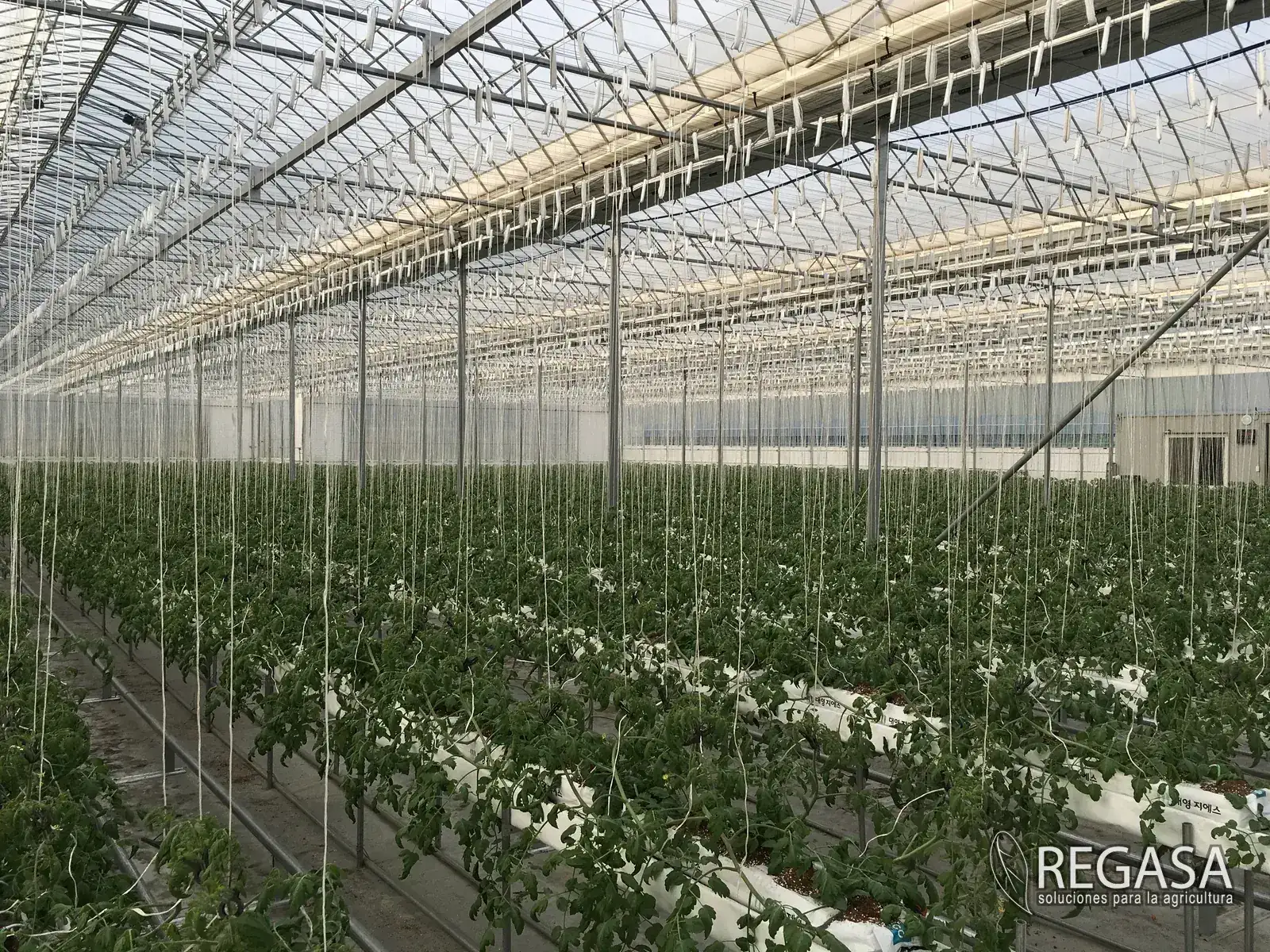
Ventilation is the most commonly undersized system in a greenhouse, and the reason is that its failure does not look like a ventilation failure.
It looks like disease pressure. It looks like poor fruit set. It looks like a crop that stalls in July. Growers go looking for a pathogen or a nutrient problem when what they have is air that is not moving.
Here is how to tell which type of ventilation your site actually needs.
What ventilation is doing
Three jobs, and only the first one is obvious.
Removing heat. Sun on a closed greenhouse pushes the inside temperature far above the outside air. Ventilation swaps that hot air for cooler outside air.
Removing humidity. The crop transpires all day. In a closed house that moisture accumulates, condenses on the covering, and drips onto foliage. Wet leaves are where most fungal disease starts. This job matters as much as the heat job and gets a fraction of the attention.
Replacing carbon dioxide. A dense crop in a sealed house depletes the CO2 around it and photosynthesis slows down. Air exchange puts it back.
A house can be at a perfectly comfortable temperature and still be badly ventilated on the second and third counts.
Passive: the default, and further than people think
Passive ventilation moves air with no electricity: roll-up side curtains and roof vents.
The physics is simple. Hot air rises and leaves through the ridge, cooler air enters low through the sides, and the movement sustains itself as long as there is a temperature difference. Wind adds to it.
When passive is enough: temperate climates, moderate summers, narrow structures, and any site where the outside air is genuinely cooler than what you want inside.
What makes passive work: total opening area relative to floor area, and openings on both the sides and the ridge. Side vents alone produce much weaker movement than sides plus ridge, because you need somewhere for the hot air to exit at the top.
The limit: passive cannot make air colder than outside. When the outside air is 95°F, moving more of it through does not solve your problem.
Passive is cheaper to install, has nothing to fail, costs nothing to run, and is the right answer for a large share of US sites. Do not let anyone talk you past it if it fits.
Forced: when the house is too big or the air too still
Forced ventilation uses exhaust fans to pull air through on demand, usually with intake at the opposite end.
When you need it: wide or gutter-connected structures where the distance from side to ridge is too great for natural movement to be effective; sites with little wind; and operations that need consistent, controllable air exchange rather than whatever the weather provides.
Circulation fans are a separate thing. These move air inside the house rather than exchanging it with outside. They eliminate the still pockets where humidity sits and disease starts, and they help enormously with uniformity in a tall crop. They are cheap, they are often skipped, and they solve problems people spend a lot more money on.
Forced ventilation costs electricity every hour it runs, which is the real trade against passive.
Evaporative cooling: when you need air colder than outside
A pad and fan system pulls outside air through a wall of wetted pads. The water evaporates, which takes heat out of the air, and what enters the house is several degrees cooler than what is outside.
When it works: hot and dry. The drier the incoming air, the more it can be cooled, because evaporation is what does the work.
When it does not: hot and humid. In a Gulf Coast summer the incoming air is already close to saturated and there is very little cooling available. Growers in humid climates who install pad and fan expecting the results advertised in Arizona are disappointed, reliably.
This is the single most important regional distinction in greenhouse climate control, and it is why a system that transforms a season in New Mexico does very little in Florida.
How to pick
Start from two facts about your site: how hot does it get, and how humid is it when it is hot?
Temperate, moderate summers. Passive, sized properly. Add circulation fans.
Hot and dry. Passive plus evaporative cooling. This is where pad and fan earns its cost.
Hot and humid. Passive plus forced, sized generously, plus circulation fans. Accept that you are managing the peak rather than eliminating it, and consider shade as part of the answer.
Wide or gutter-connected, any climate. Forced, because natural movement will not reach the middle.
Cold climate. You still need ventilation. Winter humidity management is a real problem in a sealed house, and a small amount of controlled exchange on cold days prevents a lot of disease.
Each state page on this site names the main climate constraint for that state. See greenhouse guidance for all 50 states.
Two mistakes worth avoiding
Automating an undersized opening. A controller managing a vent that is too small is an expensive way to be uncomfortable. Get the sizing right, then automate. We ranked automation priorities in where automation actually pays.
Ventilating without screening. Open vents are an open door for aphids, whitefly and thrips, which are the vectors for most of the virus problems in protected crops. Screening the openings is standard practice, and mesh selection is its own decision. See insect netting mesh sizes.
Where to start
Tell us your span, your crop and your county and we size the openings from the climate rather than from a package. See ventilation and cooling systems for what each configuration involves, or the greenhouse project form to have it worked out for your site.
What we build
The products behind this article
Want this sized for your farm?
Tell us your crop, your acreage and your state. An advisor comes back with the structure that fits your climate, within one business day. No obligation.
Keep reading