
 Guatemala
  México
  Perú
Perú  Costa Rica
  USA
USA Sustainable Greenhouse Technology: What Pays Back and What Doesn't
Not every sustainable greenhouse technology earns its cost. Which ones pay back commercially, which need scale, and which are still marketing.
Sustainability in greenhouse production has a credibility problem, and it is not the growers’ fault. The word gets attached to everything from a genuine 50% cut in water use to a solar panel on a shed that runs a light bulb.
A commercial grower cannot afford the difference between those two. So this is a sorting exercise: what actually reduces inputs enough to show up on a balance sheet, what needs scale before it makes sense, and what is still mostly a story.
What pays back on almost any operation
Drip irrigation
This is the least glamorous item on the list and by far the strongest.
Overhead and furrow irrigation lose water to evaporation, runoff and wetting ground where nothing is growing. Drip puts it at the root. The reduction is large enough that in water restricted regions it is often the difference between farming and not farming.
The second effect is bigger than the first and rarely mentioned: dry foliage. Water on leaves is how a lot of fungal disease starts. Growers who switch to drip usually find their spray program shrinks, and fewer sprays means less chemical, less labor and less residue on export fruit.
Both effects, less water and fewer applications, land on the same page of the accounts. That is why this one is first.
The cover itself
A greenhouse is a sustainability technology and nobody markets it that way.
Growing under cover cuts water use, cuts pesticide use because you have a physical barrier against the insects that carry virus, and raises yield per acre. More food from less land, less water and less chemical is the whole definition, and it happens as a side effect of a structure you bought for other reasons.
Insect netting
A screen on the vents is a low tech, low cost barrier that keeps whitefly, thrips and aphids out. It is the cheapest pest reduction available and it works without any input at all.
The tradeoff is airflow, since a finer mesh restricts ventilation, and that has to be accounted for when the openings are sized. See our insect netting page for how mesh and airflow trade against each other.
What pays back once you have scale
Fertigation
Feeding through the irrigation line means the crop gets what it needs when it needs it, instead of a broadcast application that partly runs off.
The environmental case is real: less fertilizer applied, less leaching into groundwater. The financial case got much stronger recently, because fertilizer prices rose roughly 37% between 2020 and 2025. Precision matters more when the input is expensive.
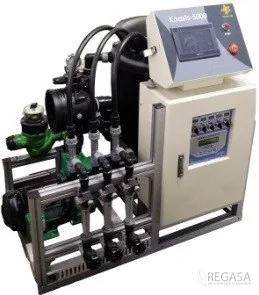
The reason this sits in the second tier is that it needs enough area to justify the controller and the injection equipment. On a small plot, manual feeding is fine. Past a certain size it stops being fine, and that threshold is where systems like the Koasis 5000 start to make sense.
Rainwater capture
A greenhouse roof is a large, clean catchment surface, and the water coming off it has no salts. In regions where irrigation water is hard or restricted, catching roof runoff is one of the highest return moves available.
It needs storage, and storage needs space and capital. That is the only reason it is not in the first tier.
Thermal screens
A retractable screen pulled across at night holds heat in and cuts heating demand meaningfully in cold climates.
It only pays where you are actually heating through a real winter. In the South it is close to irrelevant. This is a good example of a technology that is genuinely sustainable and genuinely a waste of money, depending entirely on your latitude.
What is still mostly a story
Solar on the greenhouse roof
The problem is geometric. Every panel you put on the roof shades the crop underneath, and light is the input you are least willing to give up. Semi transparent photovoltaics exist and continue to improve, but the tradeoff between energy generated and yield lost has not resolved in favor of the grower for most crops.
Solar on an adjacent building or a field edge is a different conversation and often a good one. Solar on the growing area is still an experiment.
Closed loop everything
Fully closed systems that recirculate all water and nutrients are technically impressive and operationally demanding. They require water treatment, constant monitoring and a level of technical staffing that most operations do not have and should not pretend to have.
There is a version of this that works: capture and reuse drainage water on a defined part of the operation. That is achievable. Full closure is a project, not a purchase.
Carbon neutral claims
Be careful here, particularly if you sell to retail buyers who audit. A greenhouse reduces some inputs and increases others, notably energy if you heat. The honest position is that protected growing improves resource efficiency per pound produced, which is defensible and measurable. Anything stronger than that needs an actual accounting, not a brochure.
How to decide
The pattern in this list is not complicated. The technologies that pay back are the ones that reduce a recurring input you are already buying every season: water, fertilizer, chemical, labor.
The ones that need scale are the ones with fixed capital that has to be spread across enough area.
The ones that are still stories are the ones where the environmental benefit is real but the operational cost lands entirely on you.
Start with what you buy every week. That is where the return is, and it happens to be where the sustainability gain is too.
If you want to see which of these fits your operation and your climate, tell us about it through the project form.
What we build
The products behind this article
Want this sized for your farm?
Tell us your crop, your acreage and your state. An advisor comes back with the structure that fits your climate, within one business day. No obligation.
Keep reading