
 Guatemala
  México
  Perú
Perú  Costa Rica
  USA
USA Nursery Stock and Propagation Under Cover
The largest slice of US greenhouse area that food-focused conversations ignore. Here propagation is not a preference, it is a requirement.
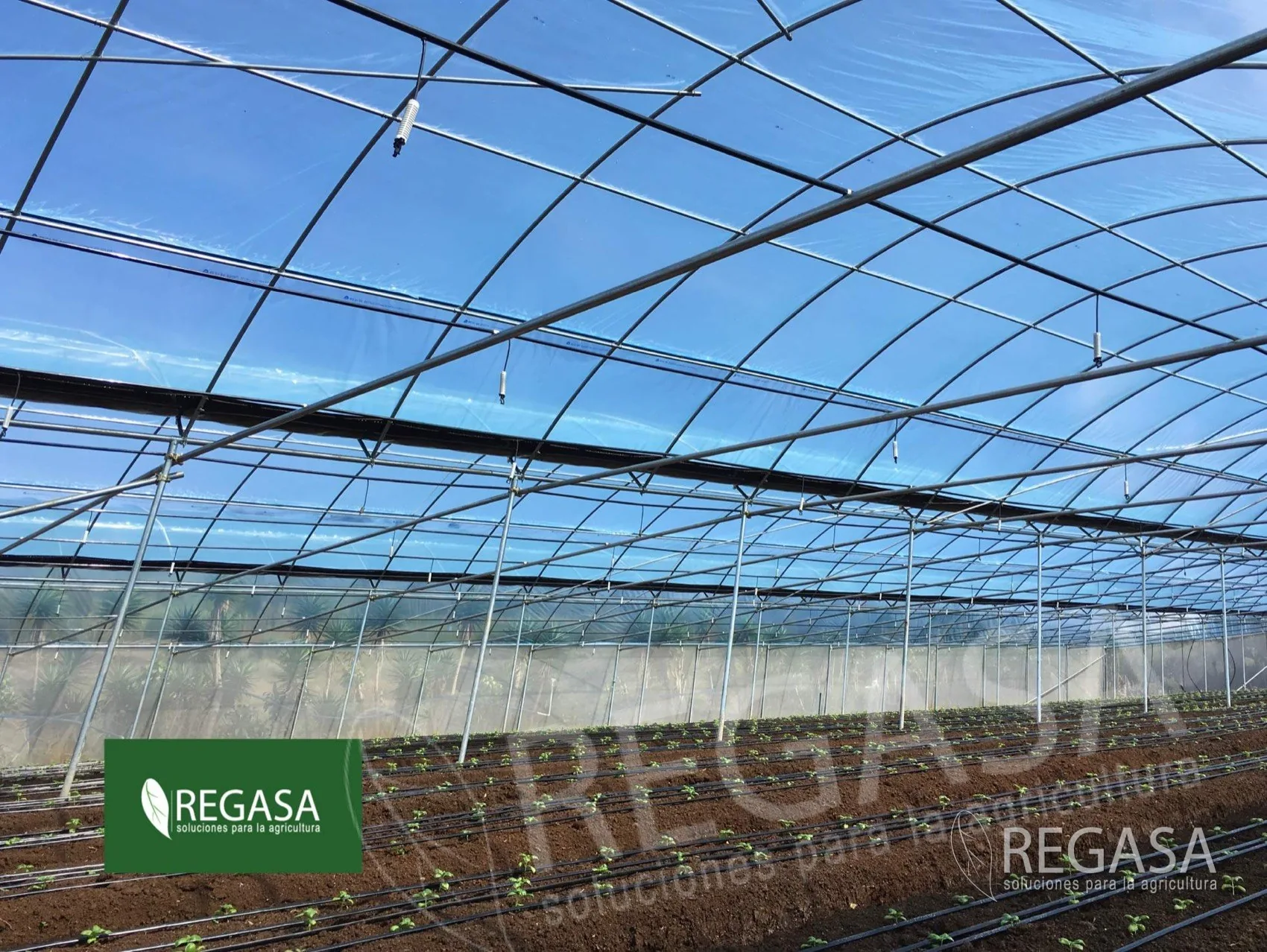
Most conversations about greenhouse farming are about food. A large share of the greenhouse area in the United States is not growing food at all.
Nursery stock, propagation, bedding plants and potted plants occupy an enormous amount of protected space, and the production model is different enough from vegetables that growers crossing over are frequently surprised.
Why propagation has to be under cover
For food crops, a structure improves the outcome. For propagation, it is closer to a precondition.
Uniformity is the product. A tray of transplants where 90% root and 10% do not is not a 90% yield, it is a tray you cannot sell. The buyer needs a full, even tray of plants at the same stage. Uniformity is not a quality bonus in this segment, it is the entire specification.
The window is narrow. A cutting either roots in the right conditions or it does not. Humidity, temperature and light have to sit in a tight range for a specific period, and the open field does not offer that in any season.
The material is expensive and small. A tray of cuttings represents real money in a very small area, which changes the calculation about protecting it entirely.
Why nursery stock benefits differently
Container nursery stock is a longer game with different pressures.
Winter protection. Containerized roots are far more exposed to cold than roots in the ground, because there is no soil mass insulating them. Overwintering under cover is how a nursery avoids losing inventory that took two years to produce.
Timing to a retail window. Nursery and bedding plants are sold into a compressed spring retail season. Being ready two weeks late means selling into a market that has already moved on. Protection is how you steer the crop to a date.
Quality that is visible on the bench. Retail plants are bought on appearance. Wind damage, sun scald and irregular growth are the difference between full price and markdown.
What the structure has to deliver
Different emphasis from a vegetable house.
Humidity control, in both directions. Propagation needs high humidity to root cuttings and then needs it dropped for grow-out. That is an active requirement rather than a passive one, and it needs ventilation you can actually modulate. See ventilation and cooling systems.
Even light. Uneven light across a bench produces uneven plants, and uneven plants do not ship. Light diffusion in the covering does real work here. See greenhouse film.
Bench-level air movement. Dense trays hold humid air in the canopy, and that is where damping-off and botrytis start. Circulation fans are core equipment in propagation, not an accessory.
Precise, gentle irrigation. Propagation needs frequent light water, and grow-out needs something different. This is a segment where irrigation control is not a convenience, because the difference between correct and slightly wrong is a whole tray. See Koasis 5000 fertigation control.
Clean everything. Disease moves through a propagation house faster than anywhere else in horticulture, because the plants are dense, young and genetically identical. Sanitation is a system, not a habit.
The tray is part of the crop
An area that gets overlooked: the container itself shapes the root system, and the root system is what the buyer is actually paying for.
Cell size determines how long a plant can hold before it needs transplanting, and cell geometry affects whether roots circle or run straight down. A plant that spirals in the cell carries that defect into the field.
See seedling trays, 32 to 512 cells for the range and what each size is for.
The NRCS question
Propagation and container nursery stock do not grow in the natural soil profile, which means they do not meet conservation practice standard 325. This segment is not eligible for the USDA NRCS High Tunnel Initiative.
That is worth knowing early rather than discovering during an application. See what NRCS will not pay for.
Who is in this segment
Nurseries growing their own liners instead of buying them in, which is a vertical integration move that pays off in cost and in control over timing.
Vegetable and berry growers propagating their own transplants, which is common and which quietly improves the whole operation, because a uniform transplant is the cheapest yield improvement available in any field crop.
Dedicated propagators supplying other growers, which is a specialist business with demanding customers and a tolerance for very little variability.
Where a structure fits
For seasonal propagation and overwintering, a high tunnel does a great deal for very little capital, particularly for the winter protection job.
For year-round propagation where humidity and temperature have to be held in a tight range, this is a commercial greenhouse application, and the climate control is not optional.
For a nursery scaling up bench area, gutter-connected bays give you the ability to run different sections at different conditions, which matters when propagation and grow-out are happening at the same time. See the Hybrid R multi-bay tunnel.
To have it sized for your bench area and your crop schedule, the greenhouse project form takes five steps.
What we build
The products behind this article
Want this sized for your farm?
Tell us your crop, your acreage and your state. An advisor comes back with the structure that fits your climate, within one business day. No obligation.
Keep reading