
 Guatemala
  México
  Perú
Perú  Costa Rica
  USA
USA Commercial Tomato Farming Under Cover: The Economics
Tomato is the most grown protected crop in the country and the most demanding. What drives the economics, and the three things that decide whether it works.
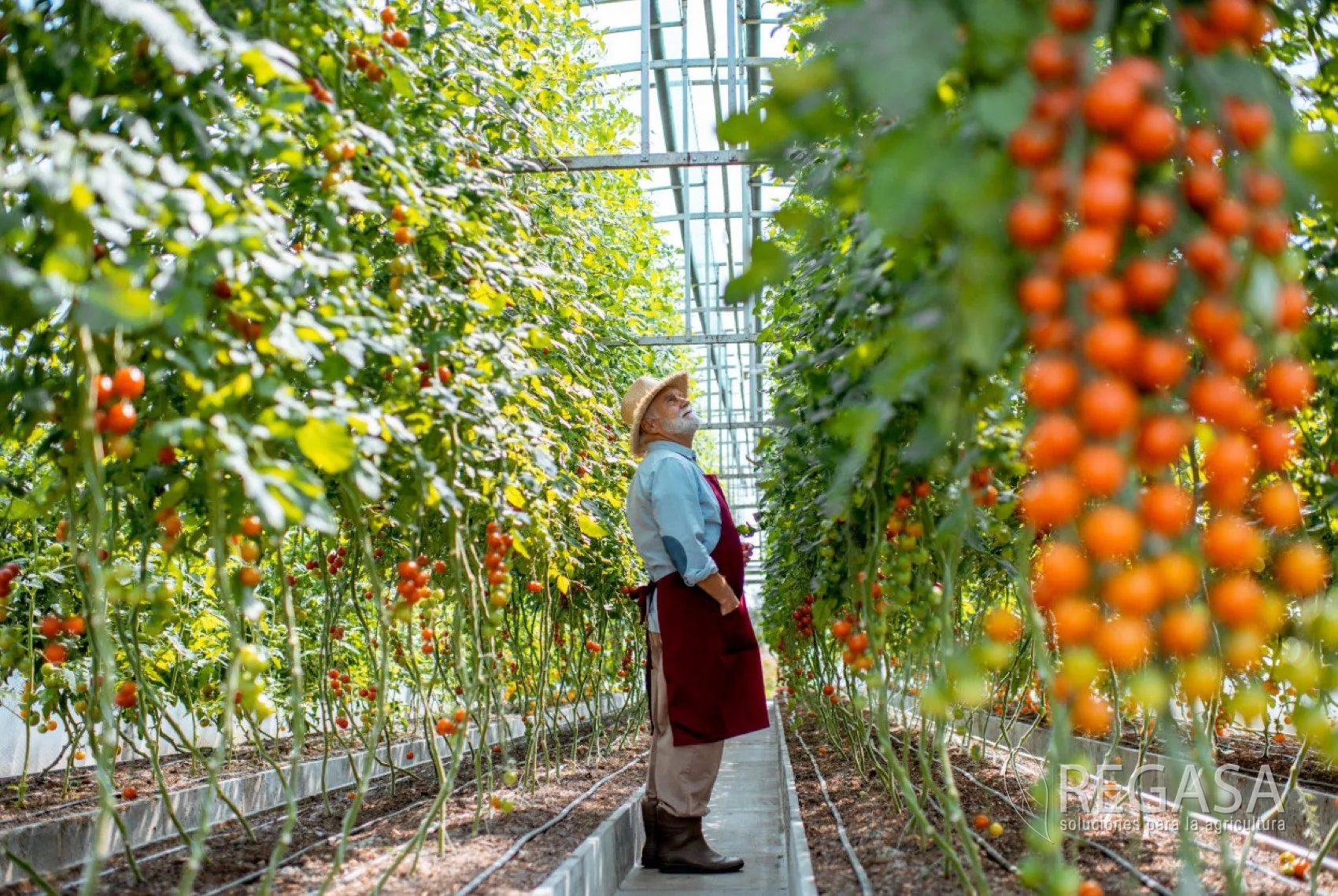
Tomato is the most grown protected food crop in the United States, and it is also where the most money gets lost.
Both facts have the same cause: the yield potential is genuinely high, which attracts growers, and the management demand is genuinely high, which is what separates the operations that hit that potential from the ones that do not.
Here is what actually drives the economics.
Why tomato dominates protected growing
Yield per square foot is exceptional. A trellised indeterminate tomato under cover produces on a scale that open-field production does not approach, because you are harvesting from a plant that keeps growing for months instead of one that sets and finishes.
The cycle is long. One planting produces for months. That spreads your establishment cost across a great deal of production, which is the opposite of a short-cycle crop where you pay to plant repeatedly.
Quality is visible and buyers pay for it. Tomato is a crop where the difference between good and excellent is obvious to the buyer and shows up in the price.
The market is year-round. Demand does not have a season, which is exactly what makes off-season supply valuable.
Where the money actually goes
Four cost centers, and the ranking surprises people.
Labor is the largest, by a wide margin. Trellised tomato is a labor-intensive crop: pruning, clipping, lowering, leaf removal, harvest. This is not a crop where protected growing reduces headcount. It changes the kind of labor, from unskilled seasonal to skilled and continuous. With labor up nearly 50% between 2020 and 2025, this line dominates the budget.
Climate control is second, and it is regional. In a northern winter, heating is a serious operating cost and it is why some operations run seasonally rather than year-round. In the South, cooling is the constraint instead, and evaporative cooling only works where the humidity is low. See greenhouse ventilation: passive, forced, and when you need which.
Plant material and inputs. Grafted plants cost more and are standard in commercial protected tomato for a reason: disease resistance and vigor over a long cycle.
The structure itself. Capital, amortized. It is the line everyone focuses on and it is not where the season is won or lost.
The three things that decide whether it works
Your climate, and specifically your winter
The economics of year-round tomato are completely different in Michigan than in Georgia, and the variable is heating.
In a cold climate you have a real decision: heat through the winter and pay for it, or run a long season and rest through the coldest months. Both are legitimate. Growers who assume year-round production without pricing the heat are the ones who get surprised.
In a hot climate the mirror problem is summer. A tomato crop above its temperature range stops setting fruit, and the ventilation has to be sized to prevent that, not to make the house comfortable.
Your market, before you plant
Tomato from a controlled environment competes on quality, freshness and reliability. It does not compete on price against field production or against imports.
That means you need a buyer who values those things: regional wholesale, retail that markets local, foodservice, direct sales. Sort this out before the first plant goes in, because a long-cycle crop with no buyer is a long-cycle problem.
Your labor, honestly assessed
This is the one that catches people.
A trellised tomato crop needs consistent skilled attention every week for months. Not a burst at planting and a burst at harvest, a steady requirement throughout. If that person does not exist on your operation, the crop underperforms regardless of the structure.
The upside is that the conditions inside a greenhouse are genuinely better than a field in August, and skilled workers who like the conditions stay. Retention is a real advantage in this crop.
What the structure has to deliver
Tomato is demanding of the building in specific ways.
Height. Indeterminate tomato grows tall and needs a trellis system, which means a structure with the height and the internal support to carry it.
Ventilation capacity. Fruit set fails above a temperature threshold, and that threshold arrives every summer.
Humidity management. Tomato transpires heavily. Without air exchange the humidity climbs, condensation forms and fungal disease follows. Circulation fans do a great deal of work here for very little money.
Dry foliage. Drip rather than overhead, always. Water on tomato leaves is how a lot of disease programs begin. See GreenDrip and BlueDrip drip tape.
Consistent feeding. A long-cycle crop with changing nutrient demand across its stages is exactly what fertigation is for. See why fertigation pays back faster now.
The honest entry path
Most successful protected tomato operations did not start with a year-round climate-controlled house.
They started with a high tunnel and a season-extended crop, learned the trellising and the climate management on a lower-capital structure, proved the market, and then built for year-round production with real numbers instead of assumptions.
The learning transfers completely. The capital risk does not.
Where to start
If you are working out whether the numbers hold on your farm, is a greenhouse a good investment walks through the arithmetic with your own figures.
For the structure sized to a trellised crop in your county, see commercial greenhouses or the greenhouse project form.
We also covered the first-year experience in greenhouse tomatoes, year one.
Cost changes come from American Farm Bureau Federation market analysis of 2020 to 2025. Yield ranges vary by state, variety and system; use your extension service.
What we build
The products behind this article
Want this sized for your farm?
Tell us your crop, your acreage and your state. An advisor comes back with the structure that fits your climate, within one business day. No obligation.
Keep reading