
 Guatemala
  México
  Perú
Perú  Costa Rica
  USA
USA What Greenhouse Technology Actually Means for a Commercial Grower
Greenhouse technology is a vague term that hides five separate decisions. Here is what each one does, which ones matter first, and where growers overspend.
“Greenhouse technology” is one of those phrases that means everything and therefore nothing. Search it and you get vertical farming startups, Dutch climate computers, LED spectrum charts, and a lot of renderings of buildings nobody has actually built.
None of that helps if you are a grower trying to decide what to buy this year.
So here is the plain version. Greenhouse technology is not one thing. It is five separate decisions stacked on top of each other, and they do not carry equal weight. Get the first two right and the rest can wait. Get them wrong and no amount of sensors will save the operation.
1. The structure, which decides everything above it
The frame is the only part you cannot upgrade later. Everything else bolts onto it.
What matters here is span, height and load rating. Span decides how many rows fit and whether equipment can turn inside. Height decides your air volume, and air volume is what buffers temperature swings. A low structure heats up and cools down fast, which is exactly what you are trying to avoid.
Load rating is the part growers underestimate. A frame is engineered for the snow and wind it will actually see at your site, not for an average. That is why a structure that works in Georgia is the wrong structure for Michigan, and why a catalog kit sold nationwide is a compromise everywhere.
Galvanized steel without welds matters more than it sounds. Welds are where corrosion starts, and a greenhouse lives in permanent humidity.
2. The covering, which decides your light and your heat
This is the decision with the shortest feedback loop. You will see the result in your first crop.
Polyethylene film in a multi layer, UV stabilized grade is the working standard for commercial production in the US. The properties that matter are diffusion, thermicity and anti drip.
Diffusion scatters direct sun so the light reaches the lower canopy instead of burning the top of the plant. In tomato and pepper, that alone changes fruit quality. Thermicity holds daytime heat into the night, which is where you save on heating. Anti drip keeps condensation running down the film instead of dripping onto the crop, and that single property cuts fungal pressure more than most spray programs.
Glass and polycarbonate last longer and cost considerably more up front. They make sense for permanent, high value, year round operations. For most growers entering protected agriculture, film is the right call, and the honest tradeoff is that you will re cover it every few seasons.
See our greenhouse film page for the specifications that matter.
3. Climate control, which is mostly moving air
Here is where the word “technology” starts doing damage, because it makes growers think about computers when they should be thinking about openings.
The vast majority of climate control in a commercial greenhouse is passive. Roll up sidewalls, ridge vents, and the chimney effect that pulls hot air out the top while cooler air comes in low. Sized correctly for your climate, passive ventilation handles most of the year in most of the country.
Forced air, wet walls and fans come in when passive is not enough, which in the US usually means summer in the South and Southwest. Heating comes in at the other end, and how much you need depends entirely on the two decisions above.
The mistake is buying automation before you have the openings right. A controller that manages an undersized vent is an expensive way to be uncomfortable.
Our ventilation systems page covers how the sizing is done.
4. Irrigation and fertigation, which is where the money is
This is the most underrated line item in the whole stack, and the one with the clearest return.
Drip puts water at the root instead of on the ground, which cuts consumption sharply compared to overhead or furrow. But the real gain is not water, it is control. Once the water goes through a line, you can put nutrients in that line, and once you can do that you can feed the crop on a schedule instead of a guess.
Fertigation is the point where a greenhouse stops being a building and starts being a system. It is also, with fertilizer prices where they are in 2026, the piece that pays back fastest.
Start with drip tape and add automated fertigation when the operation justifies it.
5. Monitoring and automation, which comes last
Sensors, controllers, data logging, remote alerts. All useful. All of it should be the last thing you buy.
The reason is simple. Monitoring tells you what is happening. It does not change what is happening. If your structure is undersized, your film is wrong and your vents are too small, a sensor will faithfully report a problem you cannot fix.
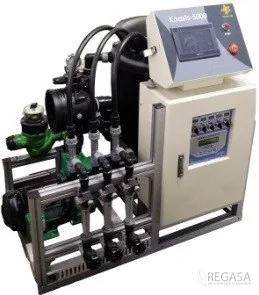
Where automation genuinely pays first is irrigation, because it runs every day, it is easy to get wrong, and the consequences compound quietly. That is why fertigation controllers like the Koasis 5000 tend to earn their place before climate computers do.
The order matters more than the list
If there is one thing to take from this, it is that these five are not a menu to pick from. They are a sequence.
Structure, then covering, then ventilation, then irrigation, then monitoring. Money spent out of order buys less than money spent in order, and most of the disappointment we see in first year operations traces back to skipping a step to afford a shinier one.
The other thing worth saying: none of this is generic. A 30 ft wide structure with heavy ventilation is right for Florida and wrong for Maine. The technology is the same, the specification is not.
If you want to see what that looks like for your conditions, tell us where you farm and what you grow through the project form, or look up the structure recommended for your state.
What we build
The products behind this article
Want this sized for your farm?
Tell us your crop, your acreage and your state. An advisor comes back with the structure that fits your climate, within one business day. No obligation.
Keep reading